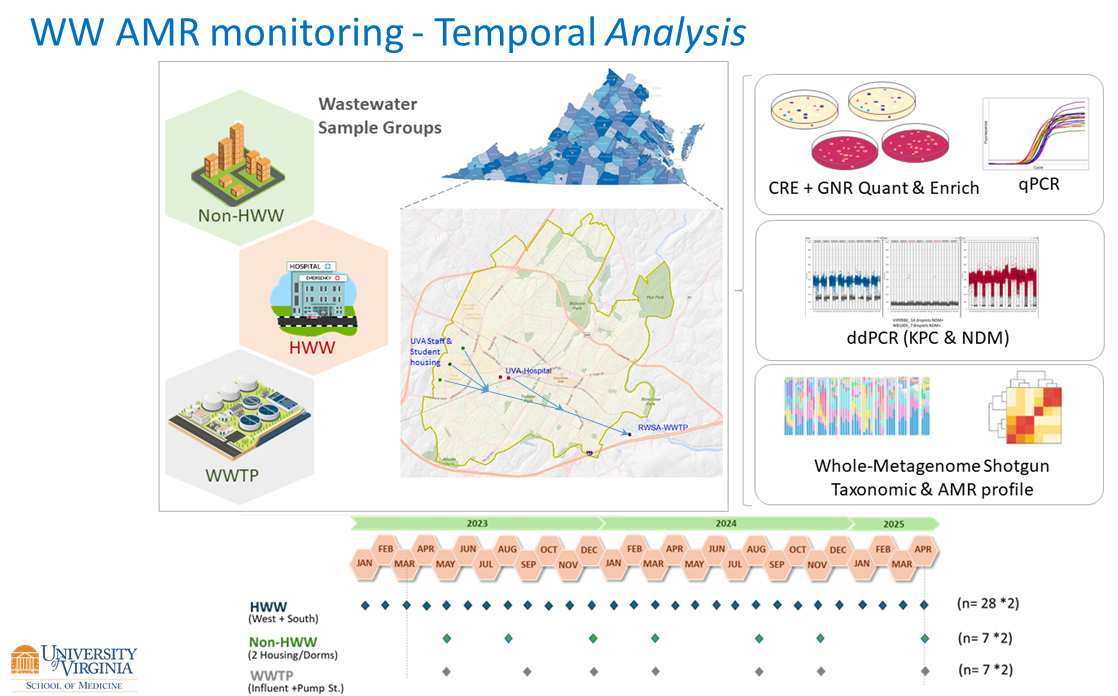
At the University of Virginia School of Medicine, we pursue the wastewater surveillance projects with an aim to develop field applications and investigations that utilize wastewater to understand the contributions to antimicrobial resistance (AMR) across Virginian communities. Advanced wastewater surveillance is a proactive tool for monitoring antimicrobial resistance (AMR) in healthcare and community settings. Our work has focused on optimizing and rigorously validating integrated quantitative & qualitative culture-based , molecular workflows as well as metagenomic sequencing to detect high risk drug-resistant bacterial population like carbapenemase-producing organisms (CPOs) and Candida auris directly from complex wastewater matrices. Through method optimization, quantitative ddPCR assays, and shotgun metagenomics (including target enrichment and hybrid capture methods) we have improved sensitivity, specificity, and reproducibility for early detection of high-priority pathogens. Longitudinal implementation across hospital, residential and downstream wastewater systems has demonstrated the feasibility of wastewater as a real-time sentinel platform for emerging resistance threats. Together, these efforts are establishing scalable, validated frameworks to support public health preparedness and early-warning surveillance for multidrug-resistant organisms. Further we are focusing on establishing bioinformatic approaches to WW metagenomic data for the detection of other emerging pathogens in the AMR and public health context, and also continue to investigate catchment-level AMR-WW monitoring to determine driving factors and transmission patterns.